I am a tenure-track Assistant Professor at Fudan University, where I am affiliated with the Institute of Computational Mechanics × AI and the College of Intelligent Robotics and Advanced Manufacturing.
My research focuses on advancing AI for scientific computing, with the goal of making complex physical systems easier to simulate, understand, and predict. I develop physics-informed and generative learning methods that bridge physical laws, observational data, and numerical modeling to address challenging problems in scientific simulation, inverse modeling, and predictive monitoring. My work encompasses neural PDE solvers, operator learning, and physics-guided generative modeling, with applications spanning geophysics, fluid dynamics, materials, and broader engineering systems.
Previously, I worked as a Penn AI Fellow at University of Pennsylvania, working with Prof. Paris Perdikaris and Prof. Nat Trask. I did my Ph.D. at King Abdullah University of Science and Technology, advised by Prof. Tariq Alkhalifah. I received my Master’s degree from Tongji University, advised by Prof. Yuzhu Liu, and Bachelor’s degree from Jilin university. I also worked as a research intern at Microsoft Research AI4Science and Microsoft Research Asia.
I am looking for motivated Ph.D. and master's students, as well as undergraduate research interns, to join my group at Fudan University. If you are passionate about AI for scientific computing, physics-informed machine learning, or scientific simulation and inverse problems, please feel free to drop me an email!
🔥 News
- 2026.02: 🎉🎉 Our CFO is accepted at ICLR!
- 2026.01: 🎉🎉 Our PhysicsCorrect is accepted at AAAI for an Oral presentation!
- 2025.10: 🎉🎉 Our neuralfwi is published at IEEE TGRS, in which we carefully analyze mechanism responsible for artifacts in operator-learning-based FWI and developed a physics-informed solution!
- 2025.08: 🎉🎉 Appointment as a Penn AI Fellow!
- 2025.04: 🎉🎉 Our videodiffco2 is published at JGR: Machine Learning and computation, the first unified probabilistic forecasting and inversion framework for CO2 storage!
Earlier highlights
- 2025.03: 🎉🎉 Our neuroseismic is published at GJI, a enhanced operator incorporating seismic knowledge!
- 2024.10: 🎉🎉 UPenn AIxScience Postdoctoral Fellow!
- 2024.04: 🎉🎉 Two papers published at Neural Networks, and one paper published at IEEE GRSL!
- 2024.03: 🎉🎉 PINN using hash encoding is published at JCP, and another paper is published at GP!
- 2024.02: 🎉🎉 One paper published at IEEE TGRS!
- 2023.05: 🎉🎉 Receive the KAUST PSE Dean’s award!
- 2023.04: 🎉🎉 NeuralStagger is accepted at ICML 2023!
📝 Publications

Diffusion-based subsurface CO2 multiphysics monitoring and forecasting
Xinquan Huang, Fu Wang, Tariq Alkhalifah
- The first unified probabilistic forecasting and inversion framework for CO2 storage, which flexibly incorporates multiple physical processes and data types and enable uncertainty quantification.

Efficient physics-informed neural networks using hash encoding
Xinquan Huang, Tariq Alkhalifah
- An efficient physics-informed neural network framework using hash encoding, which accelerates the convergence of PINN by at least 10 folds.

Microseismic source imaging using physics-informed neural networks with hard constraints
Xinquan Huang, Tariq Alkhalifah
- A direct imaging framework for microseismic source location using physics-informed neural networks with hard constraints, which can achieve high-fidelity source location results without numerical simulation and can apply to both irregular 2D and 3D data. The combination of hard constraints and novel depth causality constraint can further improve the source location accuracy. The first PINN-based realistic application.

A prior regularized full waveform inversion using generative diffusion models
Fu Wang, Xinquan Huang$\dagger$, Tariq Alkhalifah
- The first generative diffusion framework combined with full waveform inversion to achieve high-fidelity inversion results, which can further incorporate geological and well prior information by conditioning on geological and well data.
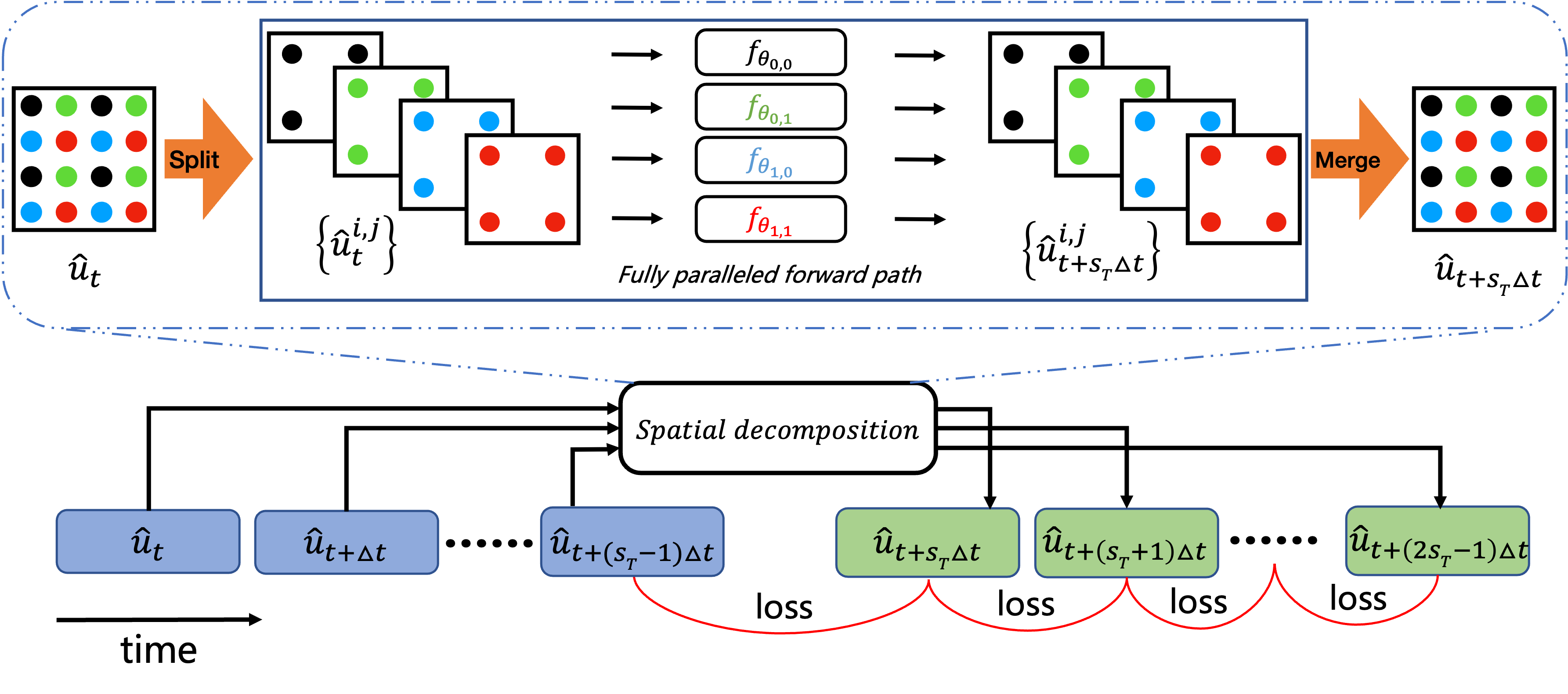
Xinquan Huang, Wenlei Shi, Qi Meng, Yue Wang, Xiaotian Gao, Jia Zhang, Tie-Yan Liu
- A novel, simple, and general spatiotemporal decomposition strategy that speeds up the solution of partial differential equations using neural networks.
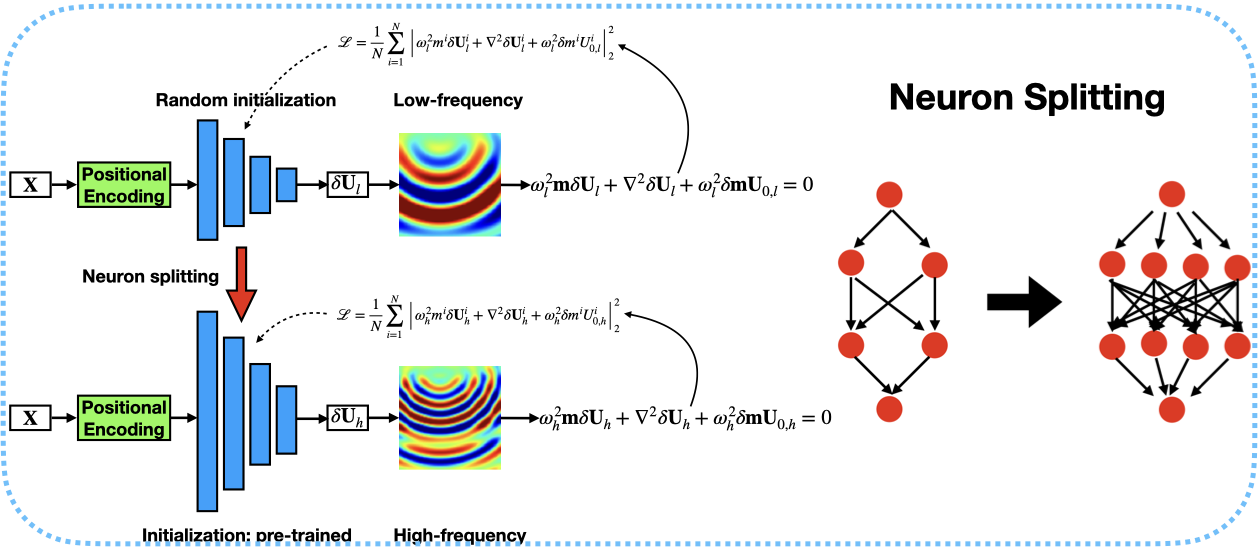
PINNup: Robust neural network wavefield solutions using frequency upscaling and neuron splitting
Xinquan Huang, Tariq Alkhalifah
- A novel physics-informed neural network framework using frequency upscaling and neuron splitting, yielding efficient, highly accurate, high-frequency wavefield solutions. The first PINN framework to achieve 32Hz wavefield solutions.
Journals and Major ML Conference Papers ($\dagger$: Corresponding Author)
- Xinquan Huang and Paris Perdikaris, (2026), Self-Flow-Matching assisted Full Waveform Inversion, in revision.
AAAI, Xinquan Huang and Paris Perdikaris, (2026), PhysicsCorrect: A Training-Free Approach for Stable Neural PDE Simulations, Proceedings of the AAAI Conference on Artificial Intelligence (AAAI), Oral, 40(26), 22057-22065. [code]- Fu Wang$^\star$, Xinquan Huang$^\star\dagger$, Tariq Alkhalifah, (2026), Geological and Well prior assisted full waveform inversion using conditional diffusion models, $^\star$: equal contribution.
ICLRXianglong Hou, Xinquan Huang, Paris Perdikaris, (2026), CFO: Learning Continuous-Time PDE Dynamics via Flow-Matched Neural Operators, The Fourteenth International Conference on Learning Representations (ICLR). [code]IEEE TGRSXinquan Huang, Fu Wang, Tariq Alkhalifah, (2025), Physics-informed full waveform inversion using learned wavefield solutions, IEEE Transactions on Geoscience and Remote Sensing, vol. 63, pp. 1-14, Art no. 4509314.GJIXinquan Huang and Tariq Alkhalifah, (2025), Learned frequency-domain scattered wavefield solutions using neural operators, Geophysical Journal International, 241, 3, 1466-1477. [code]JGR: ML and ComputationXinquan Huang, Fu Wang, Tariq Alkhalifah, (2025), Diffusion-based subsurface CO$_2$ multiphysics monitoring and forecasting, Journal of Geophysical Research: Machine Learning and Computation, 2(2), e2025JH000603. [code]Earth and Space ScienceMohammad Taufik, Xinquan Huang, Tariq Alkhalifah, (2025), Latent representation learning in physics-informed neural networks for full waveform inversion, Earth and Space Science, 12(9), e2024EA004107.JCPXinquan Huang and Tariq Alkhalifah, (2024), Efficient physics-informed neural networks using hash encoding, Journal of Computational Physics, 501: 112760. [code]Neural NetworksXinquan Huang, Wenlei Shi, Xiaotian Gao, Xinran Wei, Jia Zhang, Jiang Bian, Mao Yang, Tie-Yan Liu, (2024), LordNet: an efficient neural network for learning to solve parametric partial differential equations without simulated data, Neural Networks, 176: 106354.IEEE TGRSXinquan Huang and Tariq Alkhalifah, (2024), Microseismic source imaging using physics-informed neural networks with hard constraints, IEEE Transactions on Geoscience and Remote Sensing, vol. 62, pp. 1-11, Art no. 4503011.GPXinquan Huang and Yuzhu Liu, (2024), An efficient elastic full-waveform inversion of multiple parameters with ocean-bottom seismometer data, Geophysical Prospecting, 72, 2123–2147.Neural NetworksTariq Alkhalifah and Xinquan Huang, (2024), Physics-informed neural wavefields with Gabor basis functions, Neural Networks, 175: 106286. [code]JGR: ML and ComputationFu Wang, Xinquan Huang, Tariq Alkhalifah, (2024), Controllable seismic velocity synthesis using generative diffusion models, Journal of Geophysical Research: Machine Learning and Computation, 1(3), e2024JH000153. [code]IEEE GRSLMohammad Taufik, Xinquan Huang, Tariq Alkhalifah, (2024), Multiple Wavefield Solutions in Physics-Informed Neural Networks using Latent Representation, IEEE Geoscience and remote sensing letter, vol. 21, pp. 1-5, (2024), Art no. 7504105. [code]ICMLXinquan Huang, Wenlei Shi, Qi Meng, Yue Wang, Xiaotian Gao, Jia Zhang, Tie-Yan Liu, (2023), NeuralStagger: Accelerating physics constrained neural PDE solver with spatial-temporal decomposition, International Conference on Machine Learning (ICML), 13993-14006.IEEE GRSLXinquan Huang and Tariq Alkhalifah, (2023), GaborPINN: Efficient physics informed neural networks using multiplicative filtered networks, IEEE Geoscience and remote sensing letter, vol. 20, pp. 1-5, Art no. 3003405. [code]IEEE TGRSFu Wang, Xinquan Huang$\dagger$, Tariq Alkhalifah, (2023), A prior regularized full waveform inversion using generative diffusion models, IEEE Transactions on Geoscience and Remote Sensing, vol. 61, pp. 1-11, Art no. 4509011.JGR: Solid EarthXinquan Huang and Tariq Alkhalifah, (2022), PINNup: Robust neural network wavefield solutions using frequency upscaling and neuron splitting, Journal of Geophysical Research: Solid Earth, 127(6), e2021JB023703. [code]IEEE GRSLXinquan Huang and Tariq Alkhalifah, (2022), Single reference frequency loss for multi-frequency wavefield representation using physics-informed neural networks, IEEE Geoscience and remote sensing letter, vol. 19, pp. 1-5, Art no. 3007105.GeophysicsYuzhu Liu, Xinquan Huang$\dagger$, Jizhong Yang, Xueyi Liu, Bin Li, Liangguo Dong, Jianhua Geng, Jiubing Cheng, (2021), Multi-parameter model building in the Qiuyue structure with four-component OBS data, Geophysics, 86(5): B291-B301.PatentXinquan Huang and Yuzhu Liu, (2020), A source-receiver reciprocal elastic full-waveform inversion for multicomponent OBS data, Patent, patent number: ZL202010499751.8.CJGYuzhu Liu, Xinquan Huang, Xianwu Wan, Minao Sun, Liangguo Dong, (2019), Elastic multi-parameter full-waveform inversion for anisotropic media, Chinese Journal of Geophysics(in Chinese), 62(5): 1809-1823.GPPYuzhu Liu, Shilin Wu, Weigang Liu, Xinquan Huang, Zheng Wu, (2020), A review of seismic tomographic methods for the inversion of near-surface models, Geophysical Prospecting for Petroleum, 59(1): 1-11.
Conference Papers
SEG 2024Xinquan Huang, Tariq Alkhalifah, Fu Wang, (2024), Physics-informed full-waveform inversion using learned wavefield solutions, SEG Technical Program Expanded Abstracts, 983-987.SEG 2024Fu Wang, Tariq Alkhalifah, Xinquan Huang, (2024), A prior regularized 3D full-waveform inversion using 2D generative diffusion models, SEG Technical Program Expanded Abstracts, 988-992.SEG 2024Mohammad Taufik, Xinquan Huang, Tariq Alkhalifah, (2024), Full-waveform inversion using velocity-encoded physics-informed neural networks, SEG Technical Program Expanded Abstracts, 2142-2146.EAGE 2024Xinquan Huang and Tariq Alkhalifah, (2024), Diffusion-based subsurface multiphysics monitoring and forecasting, 85th EAGE Annual Conference and Exhibition, No. 1, pp. 1-5.EAGE 2024Xinquan Huang and Tariq Alkhalifah, (2024), Learned frequency-domain scattered wavefield solutions using neural operator, 85th EAGE Annual Conference and Exhibition, No. 1, pp. 1-5.EAGE 2024Fu Wang, Xinquan Huang, Tariq Alkhalifah, (2024), Controllable velocity synthesis using generative diffusion models, 85th EAGE Annual Conference and Exhibition, No. 1, pp. 1-5.EAGE 2024Mohammad Taufik, Xinquan Huang, Tariq Alkhalifah, (2024), Wavefield Solutions Using a Physics-Informed Neural Network as a Function of Velocity, 85th EAGE Annual Conference and Exhibition, No. 1, pp. 1-5.EAGE 2023Xinquan Huang and Tariq Alkhalifah, (2023), Microseismic source imaging using physics-informed neural networks with hard constraints: a field application, 84th EAGE Annual Conference and Exhibition, Volume 2023, p.1-5.EAGE 2023Xinquan Huang and Tariq Alkhalifah, (2023), GaborPINN: Efficient physics informed neural networks using multiplicative filtered networks, 84th EAGE Annual Conference and Exhibition, Volume 2023, p.1-5.EAGE 2023Fu Wang, Xinquan Huang, Tariq Alkhalifah, (2023), Prior probability regularized FWI using generative diffusion models, 84th EAGE Annual Conference and Exhibition, Volume 2023, p.1-5.SEG 2022Xinquan Huang and Tariq Alkhalifah, (2022), Source location using physics-informed neural networks with hard constraints, SEG Technical Program Expanded Abstracts: 1770-1774.EAGE 2022Xinquan Huang, Tariq Alkhalifah, and Fu Wang, (2022), High-dimensional wavefield solutions using physics-informed neural networks with frequency-extension, 83rd EAGE Annual Conference and Exhibition, Volume 2022, p.1-5.ICIP 2022Tariq Alkhalifah and Xinquan Huang, (2022), Direct imaging using physics-informed neural networks IEEE International Conference on Image Processing, pp. 2781-2785.NeurIPS 2021 workshopXinquan Huang and Tariq Alkhalifah, (2021), Single Reference Frequency Loss for Multi-frequency Wavefield Representation using Physics-Informed Neural Networks, NeurIPS 2021 Workshop AI4Science.SEG 2021Xinquan Huang, Tariq Alkhalifah, Chao Song, (2021), A modified physics-informed neural network with positional encoding, SEG Technical Program Expanded Abstracts: 2480-2484.SEG 2021Tariq Alkhalifah, Chao Song, and Xinquan Huang, (2021), High-dimensional wavefield solutions based on neural network functions, SEG Technical Program Expanded Abstracts: 2440-2444.SEG 2020Fu Wang, Huazhong Wang, and Xinquan Huang$\dagger$, (2020), Rotation invariant CNN using scattering transform for seismic facies classification, SEG Technical Program Expanded Abstracts: 1646-1650.SEG 2019Xinquan Huang, Yuzhu Liu,and Fu Wang, (2019), A robust full waveform inversion using dictionary learning, SEG Technical Program Expanded Abstracts:1506-1510.SEG 2019Yuzhu Liu and Xinquan Huang $\dagger$, (2019), Full waveform inversion of an OBS dataset acquired from Q field in East China Sea, SEG Technical Program Expanded Abstracts : 1655-1659.
💻 Experience
- 2026.07 - present, assistant professor A at Institute of Computational Mechanics × AI & College of Intelligent Robotics and Advanced Manufacturing, Fudan University, Shanghai.
- 2024.10 - 2026.07, Penn AI Fellow/AIxScience Fellow at University of Pennsylvania, Philadelphia.
- 2022.08 - 2023.03, research intern at Microsoft Research AI4Science, Beijing.
- 2022.05 - 2022.08, research intern at Microsoft Research, machine learning Group, Beijing.
📖 Educations
- 2020 - 2024, King Abdullah University of Science and Technology
- 2017 - 2020, Tongji University
- 2013 - 2017, Jilin University